C:\2000S\SQLITE.TXT
2000
SQLite: The Database Moves Into the Application
SQLite's early releases made SQL an application component, then rebuilt the storage machinery that made the arrangement dependable.
A small application can have a surprisingly large administrative entourage. It needs to remember some records, so you give it a database. The database needs a server, the server needs configuration, and configuration eventually needs somebody who remembers why a particular setting was changed. Your address book has acquired an operations department.
SQLite offered a different arrangement: put the database engine inside the application. The program asks for records through a library rather than sending every request to a separately running database service. SQL remains useful even when there is no database administrator waiting at the other end of a socket.
The project’s release history places its initial public alpha on May 29, 2000, and version 1.0 on August 17. Those are different milestones. Calling August the moment every feature of present-day SQLite appeared would give the first release a very generous retrospective upgrade.1
I find the placement more interesting than the size. SQLite changed where a database could belong. A database could be part of an application’s ordinary housekeeping, rather than a second system the user had to install and keep alive.
A library still has serious work to do
An embedded engine runs in the application’s process. This removes a communication boundary, but it doesn’t remove the work behind a query. Text must be interpreted, records found, comparisons evaluated, and results returned. The application also needs to know when something has gone wrong.
Compare two conceptual arrangements. In a client/server system, an application sends a request to another process. That server can coordinate many clients and protect its storage behind its own interface. With an embedded library, the call enters database code in the same process as the caller. Storage still exists; a server process does not have to mediate each operation.
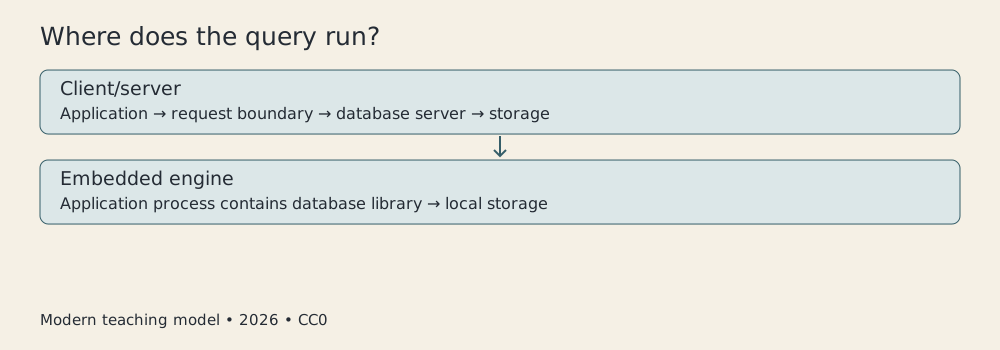
Original CC0 teaching diagram, 2026. It compares general architectures, not historical SQLite screens or exact internal structures.
This is a choice about responsibility. A central server can enforce a shared policy and collect requests from different machines. A local engine makes deployment simpler when the records naturally belong to one application or device. Neither arrangement grants permission to forget backups.
The current SQLite documentation describes the engine as embedded and serverless. Here, serverless means the absence of a separate database server, rather than a cloud provider hiding servers behind a billing interface. The same word has been made to carry rather different luggage.2
That distinction helps explain the appeal without claiming every application should use it. A shared service with many simultaneous writers has different requirements from a local catalog. Putting the engine nearby is useful when nearby is where the data ought to live.
Version one wasn’t today’s database in miniature
The early SQLite implementation used GDBM, a library for storing key/value records. The release log explicitly discusses that backend. In September 2001, the version 2 transition removed the GDBM and memory drivers and made the pager and B-tree subsystems the storage backend.1
The distinction matters. Familiar descriptions of SQLite’s later database file and recovery machinery shouldn’t be pasted over the 2000 alpha. The application-level idea arrived before all the storage properties that later made it so broadly useful.
Transactions provide a particularly sharp boundary. The April 4, 2001 entry describes limited transaction support using table locking on GDBM, without rollback or atomic commit. That is a useful warning against reading the word transaction as a promise that all modern behavior already existed.1
A lock can prevent competing access while a change is underway. It cannot, by itself, undo a half-finished sequence after a failure. Coordination and recovery are related problems, with different mechanisms.
The early log is refreshing evidence because it retains the awkward intermediate stages. A storage subsystem is added, removed, and brought back. Bugs in locking are fixed. Software history becomes more informative when the release notes are allowed to remain a work diary instead of being tidied into destiny.
An invented catalog, with real answers
Consider a small collection of software manuals. We want to record a title, the release year it covers, and the number of copies held. This is an invented dataset, not a surviving historical database.
CREATE TABLE manuals (
    title TEXT,
    release_year INTEGER,
    copies INTEGER
);
INSERT INTO manuals VALUES ('Drawing Guide', 2000, 2);
INSERT INTO manuals VALUES ('Network Guide', 2001, 1);
INSERT INTO manuals VALUES ('Editing Guide', 2000, 3);
SELECT release_year, SUM(copies)
FROM manuals
GROUP BY release_year
ORDER BY release_year;
The result is two rows: year 2000 has five copies; year 2001 has one. The table has three records, while the result has two groups. The query asks the engine to preserve that distinction.
It is worth walking through the work. Start with an empty set of totals. Read Drawing Guide and add two to the total for 2000. Read Network Guide and add one to the total for 2001. Read Editing Guide and add three to the existing 2000 total. Arrange the resulting year/total pairs in ascending year order.
That procedure is a teaching model. It specifies a correct answer, not SQLite’s chosen execution plan. A database might use temporary storage or another organization to perform the grouping. SQL lets the application state the requested relationship without choosing every step of the traversal.
The historical log records aggregation and grouping work before version 1.0. I checked this example using a modern Python sqlite3 installation, not a recovered 2000 executable. The check confirms the dataset and result; it doesn’t certify the exact syntax, representation, or performance of every early build.1
This is a modest example, deliberately. The interesting benefit isn’t that six books require a sophisticated query engine. It is that the application can grow from a few records to more complicated questions without inventing its own little query language along the way.
SQL becomes a program
SQLite’s architecture documentation describes compiling SQL into bytecode and executing that bytecode in a virtual machine. A virtual machine here is an interpreter for database instructions, not a simulated desktop computer.3
Imagine a simplified instruction sequence for our catalog: open the table, read a row, obtain its year and copy count, update a grouped total, advance, and eventually return the totals. This is explanatory pseudocode. Actual instruction names and details vary with the engine version.
The separation is useful. Parsing decides what the query means. Planning chooses a way to obtain its answer. Execution follows the resulting instructions. A query that looks short to its author can become a fairly involved program inside the engine.
It also gives debugging a place to stand. If a result is wrong, the problem may be in interpreting the expression, choosing a plan, or carrying out an instruction. Those are distinct possibilities even when the application sees only one failed query.
The current architecture page documents modern interfaces. It supplies the conceptual explanation here, while the early release log independently mentions VDBE work. This article doesn’t attribute today’s sqlite3_prepare_v2 interface to the first release. API names are dates wearing identifiers.
Two updates need one outcome
Now imagine the catalog tracks manuals in two rooms. Moving a copy requires subtracting one from the first room and adding one to the second. Start with four copies in room A and two in room B. The intended outcome is three and three, with six in total.
If the application crashes after subtracting from A but before adding to B, the stored counts become three and two. Nothing physically disappeared, but the records claim that a manual did. An orderly database can be a very convincing source of fiction.
A transaction groups the related updates. Under an appropriate atomic transaction mechanism, the durable outcome should be the old pair or the new pair, rather than a mixture. Atomic means the group becomes visible as one completed change for the purposes of this guarantee.
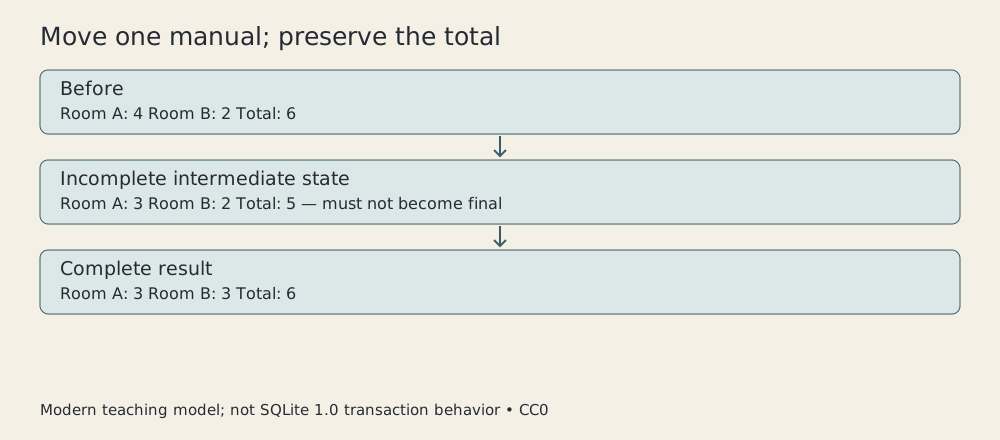
Original CC0 teaching diagram, 2026. Invented room counts illustrate all-or-nothing recovery; this is not a claim that SQLite 1.0 supplied atomic rollback.
One general recovery strategy preserves the old information before overwriting it. If the operation cannot finish, recovery restores the earlier state. SQLite’s documentation explains rollback-journal atomic commit in detail, including the ordering of writes and synchronization.4
The order is the mechanism. Saving old data only after overwriting it would be rather like buying an umbrella after the ceiling has collapsed. Recovery information must reach the necessary durable state before later steps depend on it.
Hardware and operating-system behavior complicate the promise. A write accepted by a software layer may still be waiting in a cache. The database has to work with synchronization operations and stated assumptions about storage. The word saved is much less precise than it sounds.
Our numerical example was checked by committing and rolling back updates in modern SQLite. No power failure was induced, and no historical runtime was tested. A successful rollback demonstration verifies the example’s logical behavior, not the reliability of an entire machine during an electrical surprise.
Convenience has a boundary
Embedding a database reduces installation work. It also places the database code within the application’s failure domain. If the process terminates, both application and engine stop. Durable storage and recovery then become especially important.
Concurrency is another boundary. Several readers and a stream of competing writers are different workloads. A small local file can be an excellent fit without becoming a universal substitute for a database service. The current project’s guidance explicitly distinguishes appropriate local uses from workloads better served by a client/server engine.5
These limits are part of the achievement. SQLite made a useful category of application simpler by declining to require the architecture of a different category. You don’t need to coordinate an entire enterprise merely to remember which documents a user opened.
The early chronology shows why this required more than packaging an SQL parser as a library. Storage organization, locking, recovery, and usable interfaces had to develop together. Removing the server did not remove database engineering. It moved that engineering into a component an application could carry.
That is the lasting change worth taking from the 2000 beginning. Structured storage could become ordinary application material. The user might never see a database installation screen, and the programmer could still ask a precise question of the records. There are very few installation screens whose absence needs a commemorative plaque.
Sources
Footnotes
-
SQLite project, release history, entries May 29–August 17, 2000, April 4 and September 20–28, 2001; cross-checked against release chronology. Primary project records; GDBM and later transaction boundaries retained. ↩ ↩2 ↩3 ↩4
-
SQLite project, About SQLite, modern description used for the architectural distinction, not a 2000 feature list. ↩
-
SQLite project, Architecture of SQLite, modern compiler/virtual-machine explanation; modern interface names are not backdated. ↩
-
SQLite project, Atomic Commit in SQLite, rollback-journal explanation, consulted as later technical documentation. ↩
-
SQLite project, Appropriate Uses for SQLite, modern workload guidance used to explain the architectural tradeoff. ↩