C:\2000S\WORLDOFW.TXT
2004
World of Warcraft: The Adventure Keeps a Ledger
The 2004 World of Warcraft turned quests, experience and group rewards into persistent records around which players organized their time.
An adventure can end when its window closes. A persistent online adventure has another obligation: remembering enough that returning tomorrow makes sense. The character’s progress, the outstanding tasks and the relationships with other players have to survive the end of a session.
Blizzard announced a November 23, 2004 North American release for World of Warcraft, with Windows and Macintosh versions and an ongoing subscription after the included first month. Its announcement described both solitary questing and play with others.1
Those two modes create a useful design problem. The world is shared, but progress belongs to particular characters. A group can perform one action together while the game records different consequences for each member.
The original manual makes that accounting visible. Its instructions explain quest records, experience and loot allocation alongside the fantasy. Beneath the scenery is a collection of rules about whose action counts, which reward is available and what remains unfinished.
That is the angle here: an adventure whose ledger supplies reasons to return and reasons to coordinate. The calculations below are invented teaching models, rather than measurements from a recovered launch server.
A quest has more than two states
Blizzard’s preserved manual, carrying a 2004 copyright, describes a quest log with a maximum of twenty entries. It distinguishes satisfying an objective from returning to receive the reward.2
Consider an invented task called “Supplies for the Watch.” A character accepts a request for three supply tokens, collects them and returns to the requesting character. There are at least four useful states:
not accepted → active → objectives satisfied → rewardedThe middle distinction matters. Collecting the third token makes the task ready for completion, but it doesn’t by itself perform the hand-in. The software needs to remember that readiness between the field and the return trip.
Our model gives the character zero tokens at acceptance, then one, two and three. An attempted hand-in at two fails. At three it succeeds, removes the three tokens, grants an invented reward of 120 experience and marks the task rewarded.
A second hand-in fails. Without that final state, repeating the same interaction could grant the reward again. The ledger has to record that the transaction has already happened, rather than merely that the character once possessed enough tokens.
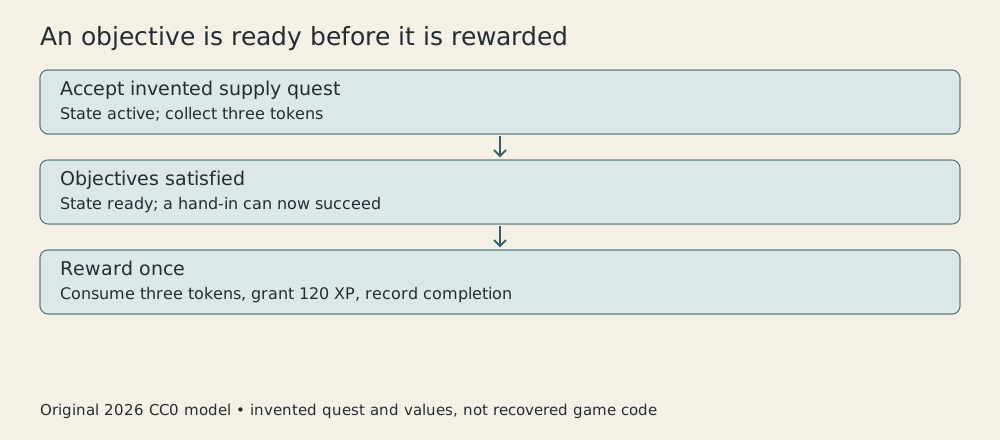
Original CC0 diagram, 2026. Teaching state machine, not a recovered quest script or historical game interface.
We execute this model with a modern Python object. The check verifies the transitions and the single reward. It doesn’t establish Blizzard’s internal database schema, message ordering or transaction implementation.
Still, it exposes a practical requirement. The reward and the consumed items need to agree. A failure that removes the items without granting the reward, or grants the reward without recording completion, produces a different adventure from the one the rules promised.
Persistent play makes these disagreements particularly consequential. They remain visible when the player returns. The attractive part of remembering progress and the difficult part of preserving consistent state are the same design commitment seen from opposite ends.
The task list is a planning interface
A quest record also gives the player something to reason about. There can be several unfinished objectives, with destinations, requirements and rewards that suggest what to do next.
Imagine two invented tasks requiring travel to the same clearing. One asks for tokens; the other asks the character to speak to a scout. Doing both on one journey can make sense. The useful information isn’t just that each task exists, but that their requirements overlap spatially.
Now imagine a third task whose reward helps with a fourth. The log becomes a small planning tool. Its contents don’t have to prescribe one perfect order to make the current alternatives legible.
A limit on outstanding tasks introduces another decision: finish something, abandon something, or decline the new request. The exact twenty-entry limit belongs to the manual’s period description. Our planning example doesn’t claim that any particular historical player organized their evening this way.
This is a practical form of accessibility. A large world can be difficult to approach without intermediate goals. A remembered task supplies a manageable next action, even if the player has forgotten the conversation that first introduced it.
It can also narrow attention. Once progress is represented as countable objectives, players may optimize the counts at the expense of exploration. The software offers a way to organize play; it doesn’t determine that everyone will find that organization equally satisfying.
Rest changes the value of a return
The manual describes rested characters receiving twice the normal experience from monster kills. Quest experience neither receives that bonus nor consumes the rest state.2
For a simplified accounting example, give each eligible kill a base value of 50 experience. Give the returning character a bonus budget of 150, enough to add 50 to each of three such kills. This budget is our model’s notation, rather than a claim about the game’s exact stored representation.
Five kills then produce 100, 100, 100, 50 and 50 experience. The total is 400. Without the bonus, the same five invented kills total 250.
Insert a quest hand-in worth an invented 120 after the first kill. It raises earned experience but leaves the remaining bonus budget at 100. The subsequent kills still receive the two available bonuses. Total experience from the five kills and the quest is 520.
This is a distinction between two counters. One records overall progress. Another records the remaining conditional benefit. Treating all experience as though it depleted both counters would give the wrong result for the stated rule.
Our check computes the sequence explicitly. We use equal-sized kills and an evenly divisible budget to avoid asserting what the period server did at a partially covered final kill. No historical leveling speed follows from these invented numbers.
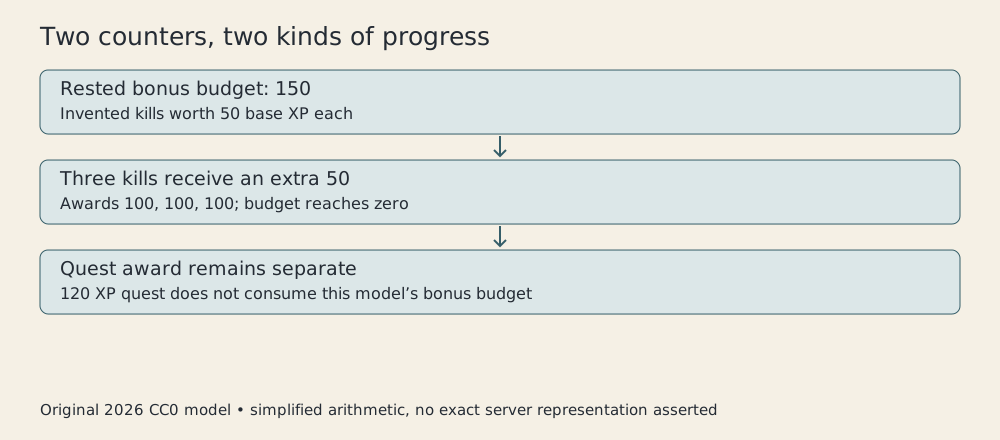
Original CC0 illustration, 2026. Invented values and simplified rested accounting; no claim about exact accumulation or internal representation.
The broader consequence is a change in the meaning of time away. A returning player can have a temporary benefit without the game having played the entire adventure on their behalf. The character still needs actions that qualify for it.
A bonus doesn’t equalize everyone. Different players choose different activities, spend different amounts of time and begin from different levels. It changes one part of the progression calculation, rather than erasing those differences.
That modest boundary makes the mechanism easier to understand. It supplies a limited advantage under stated conditions. It is neither a universal catch-up guarantee nor evidence that the game ceased rewarding sustained play.
Cooperation needs an allocation rule
The manual lists round robin, free-for-all and master looter as three group-looting systems. It separately discusses quest items that can be collected by multiple eligible members.2 A later guide listing more systems shouldn’t silently replace this period document.
To see why allocation is necessary, invent a party of three: Ada, Bram and Cy. Six defeated opponents each leave one ordinary bundle. Under a simple round-robin model, the owners are Ada, Bram, Cy, Ada, Bram and Cy.
Each receives two turns. That doesn’t prove equal value: one bundle might contain something more useful than another. Equality of opportunities and equality of outcomes are separate properties.
Under a free-for-all model, whoever arrives first can claim a bundle. That can be easy to implement as a rule and awkward to negotiate as a social arrangement. A player’s connection, attention and willingness to rush become part of the practical result.
Under a master-allocation model, one person assigns the bundles. The software grants authority; the group has to decide whether it trusts the person using it. Automating possession doesn’t automate good judgment.
Our executable check tests only the round-robin sequence. It contains no random drops, distance eligibility, item rarity or historical roll rules. The other cases describe the allocation problem rather than simulating an actual game encounter.
A shared objective and a scarce reward aren’t the same thing. Several members may deserve progress credit while only one ordinary object exists to distribute. A game that supports cooperation has to decide separately which consequences can be duplicated and which require selection.
This is where apparently small rules become social infrastructure. A group can agree before beginning, remember who behaved fairly, and choose whether to play together again. The ledger supports those interactions without being able to guarantee their success.
A service has to keep the promise working
The subscription described in the launch announcement put continued operation inside the product. The user bought access to an evolving online environment, rather than only possession of a program that could be run independently.1
That arrangement makes availability part of the experience. If the shared service is unreachable, having all the client files doesn’t perform the missing coordination. A persistent character is useful only when the player can reach the system that recognizes it.
It also creates a preservation problem. Retaining an installer or manual can document an interface and its rules without preserving an operational world. The service, its maintained state and its community are harder to keep than a disc.
The manual’s credits reflect the scale of that work: team lead Mark Kern, lead designers Rob Pardo and Allen Adham, lead programmer John Cash, and extensive art, quest, testing and operational contributions.2 A president’s launch statement isn’t a substitute for those roles.
The credits and instructions were actually read for this article. The whole manual wasn’t exhaustively reviewed, and its printed claims aren’t treated as proof of every launch-server implementation. Where documentation is our evidence, documentation is what the article reports.
The original world has a boundary
World of Warcraft changed through updates and expansions. The 2019 Classic service is also a later product, rather than a time machine that proves the behavior of November 2004. Modern instructions can be useful, but they require their own dates.
This article therefore avoids later group-finding interfaces, expansion territories, contemporary level limits and current loot rules. It makes no player-count claim and runs no game-performance benchmark.
What the original documentation does show is a carefully recorded structure for play. Tasks have readiness and completion. Experience can have conditional modifiers. Cooperation has eligibility and allocation questions. A character can return to records that make the next action meaningful.
A fantasy world needs a good deal of mundane bookkeeping. The accomplishment is making that bookkeeping support the adventure instead of asking the player to maintain it separately. Tomorrow’s journey starts with a ledger that remembers where today’s stopped.
Sources
Footnotes
-
Blizzard Entertainment, November 4, 2004 release announcement, reproduced by MMORPG.com. Primary publisher text within contemporary coverage; November 23 North American date, platforms and subscription model. ↩ ↩2
-
Blizzard Entertainment, World of Warcraft Game Manual, 2004 copyright, preserved official PDF. Printed pp. 40, 52–53, 118–120, 140–142 and 200: quest log, rest, completion, looting and credits. Selected sections read; manual wording, not exhaustive launch-server verification. ↩ ↩2 ↩3 ↩4