C:\2000S\MINECRAF.TXT
2009
Minecraft: The World Is Also the Material
Minecraft's 2009 public beginnings made a block world into a construction medium, where simple edits could change both the scene and the possibilities of play.
In many games, scenery tells the player where movement is possible. A wall blocks a route; a staircase supplies one. When the player can remove the wall or construct the staircase, scenery becomes something more active: material for changing what the world permits.
Minecraft’s publisher dates its beginnings to May 17, 2009. That public milestone belongs to the decade even though the game’s later full release and many familiar features do not.1
The early proposition was already consequential. A world built from editable blocks could be a setting and a construction medium at the same time. The player didn’t need a separate three-dimensional modeling application to make an object that occupied the space where play happened.
Markus Persson developed the early game. His initial developer statements, reproduced in a later account of the launch thread, describe influences and proposed future modes.2 Those proposals matter as intentions. They should not be turned into features already implemented on the first public day.
The original forum currently refuses retrieval in this research environment. The article therefore distinguishes reproduced excerpts from direct reading of the complete thread. Its worked construction is an original grid model, not a recovered early Minecraft world.
A small vocabulary can make a large arrangement
A block supplies a repeatable unit. Place units beside one another and a larger structure emerges. Remove selected units and the structure’s shape and navigable spaces change.
The publisher’s 2019 Classic release describes a deliberately limited selection of thirty-two blocks as a return to the 2009 experience.3 That retrospective reissue is evidence of how the publisher presents early building, rather than proof that every initial May build had precisely the same content.
A restricted palette doesn’t restrict every arrangement to the same result. Even identical units can form a tower, wall, bridge or opening. The expressive work lies partly in their placement.
This is a familiar distinction in construction media. Having fewer kinds of piece can make the unit easier to understand while leaving a large space of combinations. More assets aren’t the only route to more expressive work.
The result also differs from a picture of a building. It occupies a volume. A gap can be a passage, a roof can cover a space, and a stairlike arrangement can change an available route, subject to the game’s actual movement rules.
Our model concentrates on occupancy and exposed surfaces. It does not implement collision, physics, block textures or a historical movement system. Those boundaries keep a geometric explanation from quietly claiming to be a game runtime.
Build a cube, then remove its centre
Imagine an invented three-by-three-by-three grid. Each cell either contains one opaque unit cube or is empty. Fill every cell. The result contains twenty-seven cubes.
Its exterior has six sides, each consisting of nine unit-square faces, for fifty-four exposed faces. Faces between occupied neighbors are internal and aren’t counted as exposed in our model.
Now remove the centre cell at coordinate (1, 1, 1), with coordinates running from zero to two. Twenty-six cubes remain. The outside shape hasn’t changed, but six inward-facing surfaces now border the empty centre.
The exposed-face count becomes sixty. The six new faces belong to the six remaining cubes adjacent to the removed cell. Removing one cube can increase the number of faces bordering air.
That result is worth checking because it runs against a casual assumption that fewer blocks must always mean fewer surfaces. The geometry depends on arrangement, not only quantity.
Our Python check represents occupied cells as a set of coordinate triples. For each occupied cell, it examines the six axis-adjacent positions. If a neighbor is empty, the corresponding face counts as exposed.
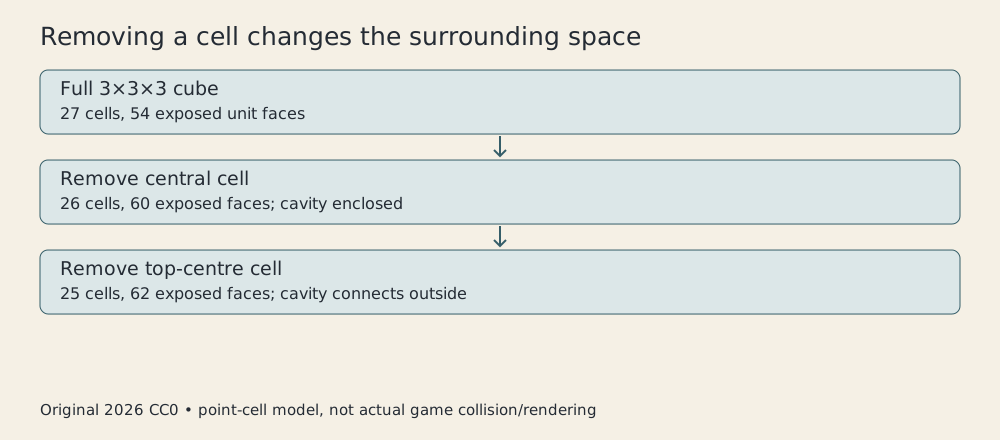
Original CC0 diagram, 2026. Invented unit-cube model, not Minecraft textures, a screenshot or a recovered map.
The rule produces fifty-four for the full cube and sixty after centre removal. This is an exact calculation for the stated model. It is not a count of actual draw calls, triangles or faces rendered by Minecraft in 2009.
A renderer may omit surfaces the viewer cannot see, combine geometry or use other rules. Our exposed-face count is a geometric input to such decisions, not a claim about their historical implementation.
Open the interior to the outside
Next remove the top-centre cube at (1, 2, 1). The grid now contains twenty-five cubes, and the central cavity connects to the exterior through the new opening.
Four adjacent cubes gain faces bordering the removed top-centre cell. Two faces belonging to that removed cell disappear from our prior count: its exterior top and its bottom bordering the cavity. The net increase is two, giving sixty-two exposed faces.
The check verifies the count by enumeration rather than relying only on the verbal calculation. The diagram explains the arrangement; the set-based calculation checks all occupied cells under one rule.
Connectivity changes too. Before the opening, the centre’s empty cell is enclosed by occupied neighbors. Afterward it has a route through the empty top-centre cell to outside the cube.
Our flood-fill check starts in that central empty cell and follows axis-adjacent empty cells within a small surrounding region. It fails to reach the surrounding boundary before the opening and succeeds afterward.
This is connectivity for a point-like cell traversal model. It doesn’t prove that Minecraft’s player could fit through the opening or move along the route. A physical character has dimensions and movement constraints that our flood fill omits.
The separation is useful. Geometry can establish that two empty regions connect under stated adjacency rules. Playability requires the additional rules of the game.
The edit changes the possibilities
Removing a unit isn’t only a visual operation. It can alter which space connects to which other space. Adding a unit can support a structure or close a passage, depending on the surrounding arrangement and the game’s rules.
That means the player can reason locally and obtain a global consequence. One missing cell can turn an enclosed interior into a connected region. The operation is small; its significance depends on where it occurs.
This is one reason the medium supports experimentation. The player can make a change, inspect the result and revise it. A failed arrangement is still an arrangement that can be edited.
Our model doesn’t need a victory condition to make that process meaningful. The intended result supplies a local goal: an opening, a roof, a recognizable shape. The player can compare the result with that intention.
A game can later supply additional constraints, but the construction mechanism is already useful without assigning later crafting recipes, hunger or progression to the earliest public build.
The reproduced developer statements are especially important at this boundary. A planned survival system was an idea being discussed. The history shouldn’t reward the plan by treating it as something a first-day player necessarily encountered.2
Coordinates make a world editable
Our grid stores occupancy at integer triples. A coordinate identifies a cell, and changing its value changes the local arrangement. That’s a teaching representation rather than an assertion about Minecraft’s exact save format.
For a simple storage calculation, imagine a sixteen-by-sixteen-by-sixteen region with one byte of block identity per cell. It needs 4,096 bytes for that single field before any headers, compression or other state.
The number follows from the invented dimensions and representation. It is not a historical chunk specification or a measurement of Minecraft’s memory use. The term “region” here means only our chosen grouping of cells.
Grouping can help localize work. A change in one area needn’t require rewriting an unlimited world description in the model. But a boundary between groups creates obligations: neighboring cells can still affect exposed faces and connectivity.
If a cube at the edge of one group has a neighbor in the next, its shared face is internal. Treating every group boundary as empty would produce extra faces. The data organization has to preserve the geometric relationship.
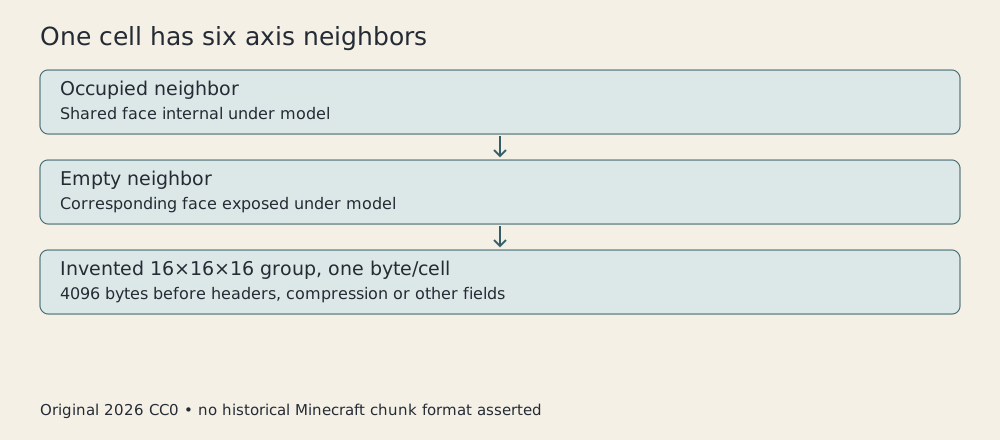
Original CC0 illustration, 2026. General cell-neighbor mechanism and invented storage calculation; no historical chunk format asserted.
This is the technical counterpart of the player’s construction experience. A simple operation on one unit has consequences for nearby units. A world representation needs to make those consequences manageable while retaining the rules that make the arrangement coherent.
A construction can become a shared explanation
A built object gives another person something concrete to inspect. A bridge or tower can show the possibilities of a small set of operations more effectively than a feature list does.
The later account of the launch thread documents rapid exchanges around early constructions.2 This article doesn’t claim to have inspected every original attachment or to have recovered the first surviving player creation.
The broader mechanism is easy to recognize. A person makes an arrangement, shows it and prompts somebody else to try a variation. What travels socially is both the object and an idea about what the tool can do.
That relationship is different from merely choosing between supplied levels. The construction medium can generate examples the developer didn’t have to draw individually. The resulting variety depends on player work as well as software capabilities.
The developer still provides the units, editing rules and world behavior. User construction doesn’t make those design choices disappear. It turns them into a vocabulary other people can use.
A later reissue isn’t an untouched historical runtime
Minecraft Classic’s 2019 browser availability is a later presentation of early play. Running it today wouldn’t automatically prove the exact behavior of the original Java applet, its environment or its first public revision.
No Minecraft binary or browser reissue was executed for this article. The geometric checks run on modern Python. They validate the original example while the historical claims remain attached to their dated sources.
The article also avoids modern command blocks, automation machinery, multiplayer service offerings and current world sizes. Minecraft’s later development is extensive; the 2009 construction idea doesn’t need those additions to explain why it mattered.
A record can be incomplete without making every statement equally uncertain. The publisher’s date is readable. The reproduced developer intentions are readable with a provenance limit. The invented cube arithmetic is fully checkable. Each provides a different kind of evidence.
The scenery becomes a first draft
Minecraft’s public beginnings made a game world into something the player could revise. The block supplied a comprehensible unit, while arrangements produced spaces and objects with consequences beyond their appearance.
The cube example shows that relationship in miniature. Twenty-seven units become twenty-six and then twenty-five. Interior surfaces appear. An enclosed cavity acquires a connection to the outside. The meaning of the space changes with its occupancy.
That is a useful way to end this decade’s series. Software didn’t merely offer more finished material to consume. It also supplied media in which users could construct, inspect and share their own arrangements.
A wall could still tell the player where movement stopped. It could now also suggest where the next edit might begin.
Sources
Footnotes
-
Cristina Anderca, Minecraft publisher, The 15th Anniversary cape, May 17, 2024. Retrospective publisher dating to May 17, 2009; no current cape/gameplay features backdated. ↩
-
Graham Smith, The first moments of Minecraft, 2011 retrospective reproducing selected 2009 Persson statements and describing the launch thread. Only reproduced primary excerpts read; original thread returned 403. Plans distinguished from implemented features. ↩ ↩2 ↩3
-
Tom Stone, Minecraft publisher, Embrace the Past with Minecraft Classic, May 7, 2019. Later reissue and limited palette description; not exact first-build runtime verification. ↩