C:\2000S\GOOGLECH.TXT
2008
Chrome: A Page Failure Gets a Smaller Address
Chrome's 2008 Windows beta treated active web content as work to separate from the browser, with process boundaries that limited some failures and created new coordination costs.
A browser hosting several applications has an awkward concentration of responsibility. Mail, a document and a reference page can all depend on the same window staying responsive. If one piece of active content misbehaves, the user would prefer to lose that piece rather than the entire collection.
Google announced Chrome on September 1, 2008, with a Windows beta planned for the following day. Sundar Pichai and Linus Upson described a browser built for increasingly active web applications, with V8 and contributions from existing open-source projects.1
The consequential architectural decision was to place boundaries within the browser’s work. Rendering content could be separated from the process responsible for the browser itself. Some failures would then have a smaller address.
That wasn’t a promise that every tab occupied its own invulnerable universe. The period engineering account is more qualified than the launch rhetoric. It explains both the separation and situations in which content shared a renderer.2
This article uses those limits and two original models: a map from tabs to failure domains, and a request crossing a restricted boundary. Neither model executes the historical browser.
One window can contain several processes
Charlie Reis’s September 11 explanation identifies browser, renderer and plugin process types. The browser managed the surrounding interface and interactions; renderers handled web content, and plugins had separate processes.2
The visible window isn’t a reliable picture of the process arrangement. Several processes can contribute to one apparent application. Conversely, several visible tabs can depend on one renderer.
That distinction makes the architecture easier to assess. Count the units that can fail independently, rather than assuming that every visible rectangle corresponds to an operating-system boundary.
Invent four tabs: mail, a mail popout, notes and a reference page. Give mail and its related popout renderer R1, notes R2 and reference R3. Give the browser interface its own process B.
mail          → R1
mail popout   → R1
notes         → R2
reference     → R3
browser UI    → B
These assignments are invented. They demonstrate sharing, not the exact outcome of navigating those applications in Chrome 2008. The historical source establishes that related tabs could share a renderer; our model explores what sharing means for a fault.
If R1 fails, mail and its popout are affected. Notes, reference and B remain marked alive in the model. If B fails, all four lose the functioning browser interface through which they are presented.
The check confirms both sets. It makes no claim that a real browser process failure leaves every renderer executing in a useful state. The user-facing model deliberately treats loss of the containing interface as affecting all tabs.
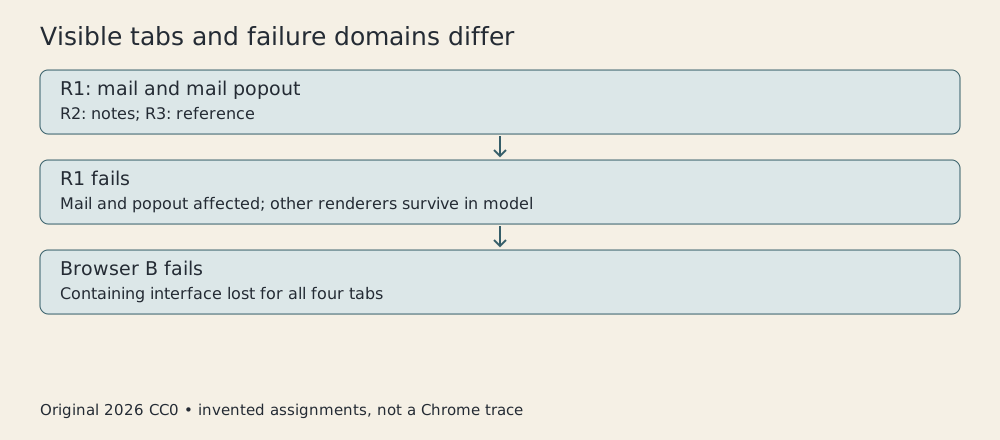
Original CC0 diagram, 2026. Teaching assignments and failure sets, not a recorded Chrome process trace.
Separation narrows some failures without removing shared dependencies. The browser process is one such dependency. Network service availability, machine resources and operating-system failures can provide others.
That is a more useful assessment than asking whether the product “has isolation” as a yes-or-no property. Isolation has a unit, a boundary and a set of conditions under which it holds.
A shared renderer shares the consequence
Now change the assignment so notes also uses R1. An R1 failure affects three tabs instead of two. The page labels didn’t change; the mapping changed.
This is why the process policy matters alongside the decision to use multiple processes. The architecture supplies a mechanism for separation. The policy decides which work receives that separation in a particular situation.
The period post notes process reuse after a renderer limit, plus gaps around cross-site frames and some navigations.2 Those qualifications prevent a modern site-isolation story from replacing the original design.
The model contains no frame tree or navigation algorithm. It doesn’t reconstruct the historical limit or decide whether a particular pair of sites would share a process. It verifies only the consequences of the explicit assignments shown.
Still, the question it raises is general: when resources become scarce, which isolation boundaries remain? An implementation that limits process count can trade some separation for a bounded overhead.
That trade isn’t automatically unreasonable. A browser has to remain usable on the computers where it runs. It is simply a trade that needs to be stated before a broad safety or reliability claim can be interpreted.
Resource accounting exposes the other side
Give an invented browser process a private memory cost of 30 MiB. Give each renderer 10 MiB of overhead before its content, and assign four pages content costs of 20, 5, 15 and 10 MiB.
With the first model’s three renderers, the simplified sum is 30 plus 30 plus 50, or 110 MiB. With all four pages inside one renderer, it is 30 plus 10 plus 50, or 90 MiB.
The twenty-MiB difference is our model’s extra renderer overhead. These figures are invented, not measurements of Chrome or a competing browser. They ignore shared physical pages, caches, allocations and every other complication of actual process accounting.
The calculation shows why a reliability feature can have a resource cost. Extra containers can improve separation while carrying their own state. The benefit isn’t sensibly evaluated by pretending the containers are free.
Now close both mail tabs. If their renderer has no remaining work and can be removed under the model, its overhead and associated content disappear together. The subtraction is 10 plus 20 plus 5, leaving 75 MiB.
The check verifies that arithmetic. It doesn’t prove the exact timing of Chrome’s renderer destruction or that all physical memory immediately returns to a particular pool. The teaching model has chosen private additive costs to keep the consequence inspectable.
A restricted process asks another process for work
A process boundary can also limit authority. Reis describes renderers running in a restrictive sandbox and going through the browser for interactions.2 The specific 2008 arrangement should not be confused with every current platform’s sandbox mechanism.
For a general model, give a renderer no direct file access. It can send a request to a broker. The broker checks whether the operation belongs to the renderer’s allowed capabilities.
Our invented renderer R2 is allowed to request the resource named page-image. It isn’t allowed to request private-notes. The broker returns the former and rejects the latter.
This is a policy model, not an operating-system sandbox. A Python function refusing a string does not prove that hostile machine code couldn’t access files. The article distinguishes the conceptual check from enforcement by a real security boundary.
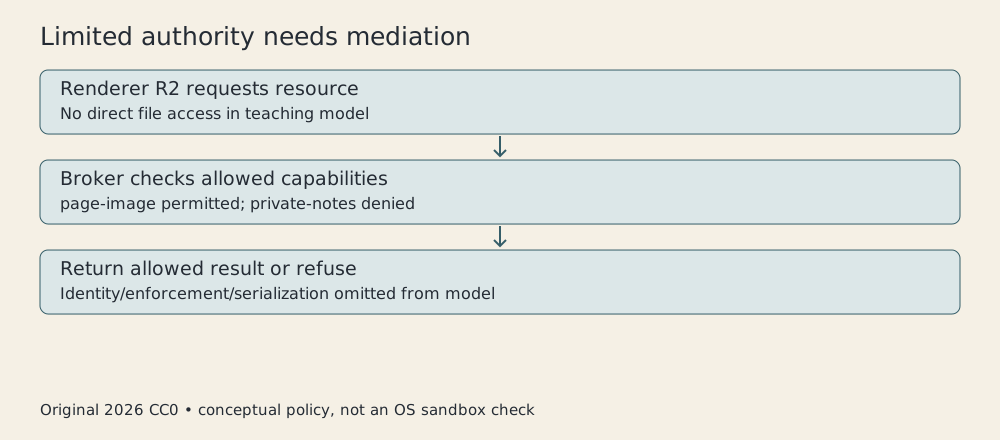
Original CC0 illustration, 2026. Simplified capability check; not Chrome IPC, a sandbox test or an exploit demonstration.
The principle is limited authority. A component can perform the work it needs without receiving every power of the program that presents it. If that component is compromised, the boundary aims to limit what it can do next.
The broker itself must handle the request carefully. Accepting an untrusted message isn’t equivalent to trusting the message’s proposed operation. The check needs an authenticated relationship to its sender and a policy appropriate to the requested work.
Our model begins with a supplied renderer identity and does not implement authentication or serialization. Those are acknowledged omissions. A readable diagram shouldn’t make a complete secure implementation look like a three-line lookup.
Communication is part of the architecture
Once work occupies different processes, information has to cross their boundary. Input travels toward content; results travel toward the interface. An operation that would once access an in-process object can require a message and an agreed representation.
That creates another form of state management. The sender and recipient may not observe the same event at the same moment. A recipient can terminate before answering. The application needs to decide what an absent response means.
A robust browser interface should remain capable of explaining that a piece of content failed. Otherwise the architecture has contained a crash technically while leaving the user unable to understand what happened.
Recovery also has a limit. Reloading a page can reconstruct what its server or retained state supplies. It doesn’t guarantee recovery of every unsaved edit that existed only inside the failed renderer.
The fault model doesn’t preserve a form draft. It deliberately checks survival sets rather than claiming data recovery. Keeping other tabs alive and restoring lost transient work are different achievements.
JavaScript performance is another question
The launch announcement introduced V8 as the JavaScript engine.1 That belongs to the same application-oriented rationale, but it isn’t the same mechanism as process separation.
An engine can improve execution of script workloads. A process boundary can limit a failure or give the operating system separately schedulable work. Neither claim automatically proves the other.
No JavaScript benchmark was run here. Invented memory costs don’t demonstrate V8 speed, and the broker example doesn’t establish a numerical security improvement. Each example is attached only to the mechanism it actually checks.
This matters because a browser launch tends to bundle responsiveness, stability and security into one persuasive account. Those qualities have related causes, but their evidence should still be kept distinct.
The beta has a date and a platform
The first announcement says Windows, with Mac and Linux work continuing. Later releases and today’s architecture don’t belong automatically to the initial beta. Chrome’s subsequent reach doesn’t change which version this article describes.
The announcement also acknowledges WebKit, Mozilla and other open-source work. Chrome was a new arrangement and product built with substantial inherited components, rather than a browser created without predecessors.1
Its important invitation was to treat the browser as a host for demanding applications. That made the cost of one page’s failure a product concern in its own right.
The worked mapping gives the invitation a concrete shape. A renderer failure affects its assigned work. Shared assignments widen that set. The containing browser remains a shared dependency. More boundaries have overhead, and restricted components need carefully mediated communication.
A browser can survive more gracefully when a bad page has a smaller address. The useful historical question is exactly how small that address was in 2008, and where the boundary still had openings.
Sources
Footnotes
-
Sundar Pichai and Linus Upson, A fresh take on the browser, September 1, 2008. Following-day Windows beta plan, application rationale, V8 and inherited projects. ↩ ↩2 ↩3
-
Charlie Reis, Multi-process Architecture, September 11, 2008. Period process roles, sharing, limits and sandbox description; full post body read, caveats retained. ↩ ↩2 ↩3 ↩4