C:\1980S\LOTUS123.TXT
1983
Lotus 1-2-3: The Spreadsheet That Made the IBM PC Worth Buying
How a fast spreadsheet, integrated charts, and dependency-aware recalculation turned the personal computer into a business modeling tool.
A monthly budget is easy to calculate until someone changes the month. A new sales estimate alters revenue, which alters profit, which alters the sensible answer to whether the business can hire another person. The addition is straightforward. Remembering every consequence is the troublesome part.
Lotus 1-2-3 made those consequences responsive. Released on January 26, 1983, it joined calculation, charts, and simple database operations on the IBM PC.12 A business model could remain a model while its assumptions changed.
That is a much better reason to buy a computer than the promise that it adds quickly. A calculator already adds quickly. It rarely volunteers to reconsider your entire plan.
The grid came first
Lotus did not invent the personal-computer spreadsheet.
In 1979, Dan Bricklin and Bob Frankston developed VisiCalc, initially for the Apple II. Its automatic recalculation let users explore changes in financial assumptions without rebuilding their arithmetic by hand.3
That distinction matters. Lotus’s achievement was not discovering that rows and columns could contain formulas. It was improving the experience and matching it to a promising new business-computing platform.
A useful invention often needs several rounds of engineering before its potential becomes obvious to a much larger audience. Lotus belongs to that second kind of story.
Cambridge, Massachusetts, and a bet on the PC
Mitch Kapor and Jonathan Sachs founded Lotus Development Corporation in 1982. Kapor helped define the product; Sachs was its principal implementer. Their company emerged from the computing community around Cambridge, Massachusetts.24
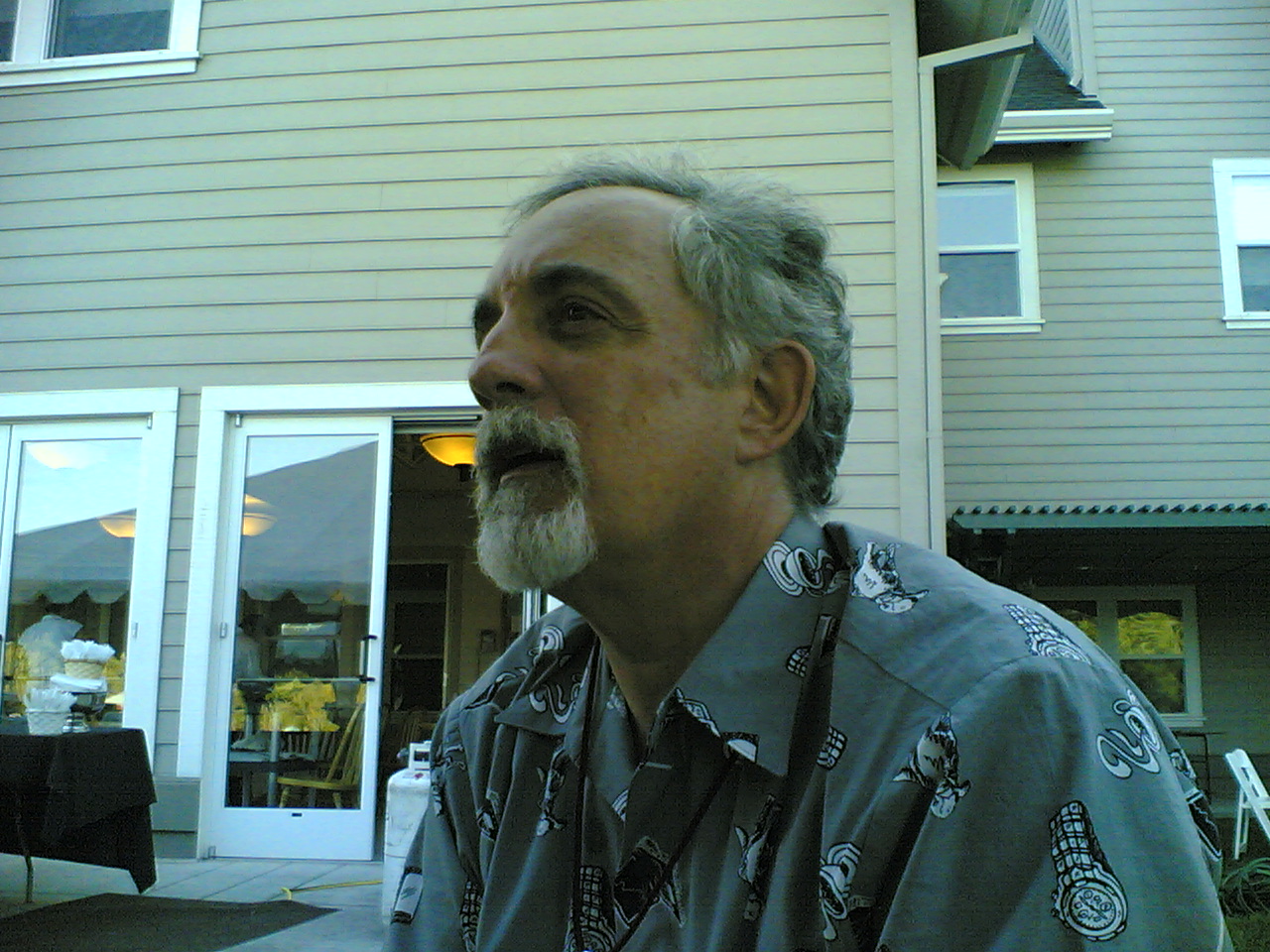
Mitch Kapor in August 2005, more than two decades after the launch. Photo: Joi / Jōichi Itō, via Wikimedia Commons, CC BY 2.0. Image reproduced without alteration.

In a 1993 oral history, Kapor explained the product’s logic: business users wanted larger worksheets and faster recalculation. The IBM PC offered a platform on which a deliberately optimized application could improve on earlier spreadsheet experiences. Combining those improvements with graphics and programmability was the business hypothesis.5
That connects several decisions that can otherwise look unrelated. Targeting a machine, choosing an implementation language, and selecting features all served the same objective: make the spreadsheet useful enough that business users would want to work in it.
Why “1-2-3” was more than a name
The product brought three capabilities together:2
| Capability | What it offered | Why the combination mattered |
|---|---|---|
| Spreadsheet | Values and formulas arranged in cells | Established a model of the business |
| Charts and graphs | Visual presentation of worksheet data | Helped communicate the model’s results |
| Basic database operations | Organization and retrieval of tabular information | Let a worksheet serve as a small information tool |
Consider a hypothetical sales table containing a region, a product, and a monthly total. The useful workflow is not just calculating a sum. It is examining the data, comparing the results, and presenting an explanation to someone else.
Keeping those activities close together reduces the work between analysis and communication. That is the design significance of integration.
The database component should not be mistaken for a modern relational database server. Nor did having three functions make Lotus a modern office suite. Its strength was bringing related activities into the spreadsheet-centered workflow.
Speed was part of the interface
Sachs described writing the original program in assembly language after finding early PC C compilers unsuitable for the efficiency he wanted. He also explained that Lotus updated the screen by addressing hardware directly where speed mattered, while using BIOS services for other operations.4
Those are implementation details with visible consequences.
If a program hesitates after every change, the user makes fewer changes. If a screen responds quickly, testing an alternative becomes a small action rather than an interruption. Performance influences which questions people bother to ask.
It is tempting to compress this history into “assembly is faster.” That misses the engineering judgment. A language does not automatically produce a fast application. Data structures, algorithms, compiler quality, hardware access, and the shape of the workload all matter.
Lotus’s implementation addressed a particular machine and a particular set of constraints. Its speed was a product decision expressed through technical choices.
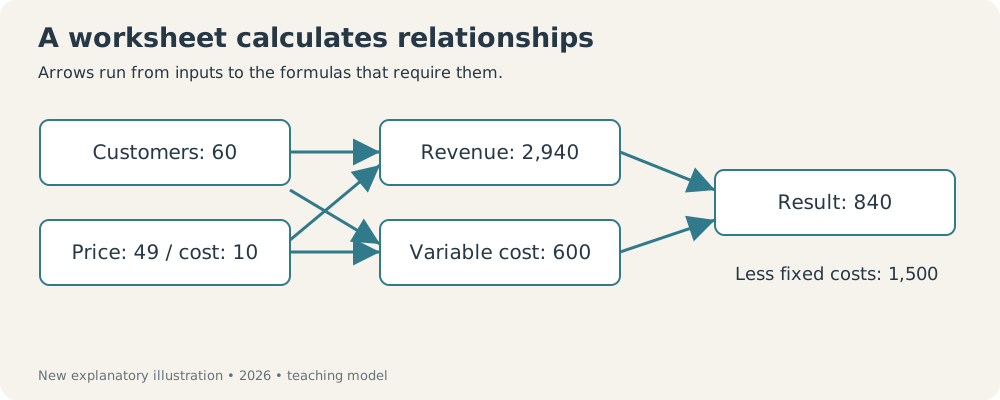
New explanatory diagram, created in 2026. The model is invented; arrows indicate prerequisites, not Lotus’s exact internal data structure.
The deeper problem: which formula runs first?
A spreadsheet contains dependencies. A profit formula needs revenue and costs; a revenue formula needs a price and a quantity.
The correct calculation order follows those relationships. It does not necessarily follow where the cells happen to sit on the screen.
Suppose a worksheet contains this simplified arrangement:
| Cell | Contents | Meaning |
|---|---|---|
| A1 | +B1+B2 | Combined result |
| B1 | +C1*2 | Twice the input |
| B2 | 10 | Fixed addition |
| C1 | 20 | Input |
The correct result in A1 is 50. To obtain it, the calculation must use the updated value of C1 when computing B1, and the updated value of B1 when computing A1.
A simple positional pass that evaluates A1 before updating B1 can use an old intermediate value. Repeated passes may eventually repair some such results, but the dependency tells us a better order directly.
Lotus’s natural-order recalculation addressed this class of problem. Sachs credited Rick Ross with adapting an algorithm that he then implemented in 1-2-3. Sachs also explicitly recalled that other natural-order implementations existed; Lotus should not receive an unsupported claim of inventing the concept.4
In general computer-science terms, cells can be represented as nodes in a directed dependency graph. For a graph without cycles, a topological ordering places prerequisites before their dependents. This describes the principle, rather than reproducing Lotus’s historical internal data structures.
A circular reference changes the problem. If A1 requires B1 and B1 requires A1, there is no ordinary prerequisite-first ordering. In this general model, following the prerequisites brings you back to where you started. The dependency graph now requires some explicit treatment of the cycle.
A worked model: from arithmetic to experimentation
Here is an original illustrative model for a monthly service business. These numbers are hypothetical, and the model leaves out taxes, financing, and many real operational costs.
The formulas use Lotus-style arithmetic entry with a leading +.
| Cell | Label | Input or formula | Initial result |
|---|---|---|---|
| B1 | Customers | 60 | 60 |
| B2 | Monthly price per customer | 49 | $49 |
| B3 | Monthly variable cost per customer | 10 | $10 |
| B4 | Monthly fixed costs | 1500 | $1,500 |
| B5 | Revenue | +B1*B2 | $2,940 |
| B6 | Variable costs | +B1*B3 | $600 |
| B7 | Operating result | +B5-B6-B4 | $840 |
The underlying relationship is:
where is the customer count, is the price, is the variable cost per customer, and is fixed cost.
With the initial assumptions:
Change B1 to 90, and the same model produces:
The value of the worksheet is the preserved relationship. The user can experiment without rewriting the reasoning for every scenario.
The break-even customer count follows from setting the result to zero:
Under these assumptions, 39 whole customers are required to cover the modeled costs. That expression assumes ; if each additional customer contributes nothing or loses money, increasing customer count cannot cover positive fixed costs in this model.
Lotus also supplied functions for ranges. The early manual gives @SUM examples using the historical double-dot range notation, such as @SUM(A1..A4).6 That syntax is worth preserving in a history article: modern spreadsheet examples are not always interchangeable with early Lotus notation.
A worksheet could become a small application
Keyboard macros gave users a way to automate command sequences. The early manual treats them as a distinct part of working with 1-2-3.6
The larger implication is that a worksheet could contain more than a one-off calculation. It could package a recurring procedure: enter assumptions, compute results, prepare output, and repeat.
That lowered the distance between being a software user and constructing a software tool. The author of a useful worksheet did not need to build a standalone application before colleagues could benefit from it.
This was empowerment, but it also made informal software easier to create. A worksheet can acquire responsibilities faster than it acquires documentation or review.
Success also reinforced a platform
The Computer History Museum describes Lotus 1-2-3 as a leading DOS spreadsheet and notes that it became a practical compatibility benchmark for IBM PC clones.2 Its account of the company’s early growth reports $53 million in first-year sales.7
Together, those facts suggest a reinforcing relationship: a successful machine attracts useful software, and useful software increases the machine’s value. Compatibility then means more than running an operating system; customers need their important applications to work.
That is an interpretation of the relationship, rather than a claim that Lotus alone caused IBM’s success. Corporate purchasing, distribution, competing software, and hardware availability belong to the broader history.
The grid is a program with unusually good manners
A worksheet supplies variables, calculations, and a way to inspect the results without asking its author to begin with a programming-language manual. Rows and columns make dependencies feel like ordinary office work. The software has managed a small social trick: it lets people program without first requiring them to identify as programmers.
That changes the risks as well as the opportunities. A copied formula can refer to a neighboring input instead of the intended one. A value entered as a constant can conceal an assumption that colleagues take to be a calculated result. A chart can give the error a title and a respectable appearance.
The worked model offers a useful check. At 38 customers, the result is −18. At 39, it is \21. Those two cases bracket the break-even count independently of the displayed formula. At zero customers, the loss should be exactly the fixed cost. If the worksheet says otherwise, it is time to inspect the references before admiring the chart.
Notice how little the check says about whether the business should exist. The arithmetic assumes the price and variable cost remain constant, treats every customer as equivalent, and leaves out capacity limits. Fast recalculation can thoroughly explore an inadequate model. It cannot discover a missing assumption on the author’s behalf.
I think that is the durable tension in Lotus’s achievement. It made a useful form of programming readily available, which also made it easier for an informal calculation to become a consequential system. The worksheet could outgrow its documentation while still looking pleasantly domestic.
A tool worth carrying to the next machine
Kapor’s platform bet and Sachs’s implementation were connected. The IBM PC attracted business attention; a responsive spreadsheet gave that attention something productive to do. The result became important enough that buyers expected competing hardware to run it properly.2
An application can therefore help define a platform from above. The required compatibility is measured through the work people need, including any hardware assumptions the application makes. An operating system’s presence on a box cannot settle that question by itself.
The business model in our example is small enough to understand on one page. Real worksheets grow. As they do, the impressive part of a spreadsheet is still the same: preserving an argument while letting its inputs vary. Lotus made that experience convincing on a machine people were already considering buying. Sometimes the killer application is the one that turns an expensive purchase into a defensible line in the budget.
A short timeline
| Date | Development | Significance |
|---|---|---|
| 1979 | VisiCalc appears for the Apple II | Establishes the earlier personal-computer spreadsheet breakthrough |
| 1982 | Kapor and Sachs found Lotus Development | Organizes the company behind 1-2-3 |
| January 26, 1983 | Lotus 1-2-3 launches | Brings its integrated business tool to the IBM PC |
| First year of sales | Lotus records $53 million in sales, according to CHM | Shows the scale of the product’s early commercial reception |
Sources and further reading
Footnotes
-
Centre for Computing History, “Lotus releases spreadsheet software Lotus 1-2-3”. Gives the launch date as January 26, 1983. ↩
-
Computer History Museum, Mitchell Kapor Fellow profile. Covers the founders, integrated features, DOS market position, and compatibility role. ↩ ↩2 ↩3 ↩4 ↩5
-
Computer History Museum, 1979 timeline, VisiCalc entry; see also Dan Bricklin’s VisiCalc history and resources. ↩
-
Computer History Museum, PC Software Workshop: Lotus 1-2-3, recorded May 6, 2004, especially pp. 4–7. A retrospective primary account by Jonathan Sachs and other participants, including Sachs’s credit to Rick Ross. ↩ ↩2 ↩3
-
Mitchell Kapor, oral history interviewed by Andy Goldstein, May 20, 1993, IEEE History Center. The article paraphrases the discussion of platform choice, performance, and product design. ↩
-
Lotus Development Corporation, 1983 user manual and update sheet preserved by CHM, chapters on formulas and keyboard macros, plus the recalculation reference. The archive bundle includes an original March 25, 1983 compatibility update and early IBM/compatible documentation. It is not an untouched January launch package. ↩ ↩2
-
Computer History Museum, “Trailblazers and Change Agents”, section on Freada Kapor Klein and Mitch Kapor. ↩